Skip to main
University-wide Navigation

Communicating with Students about Generative AI

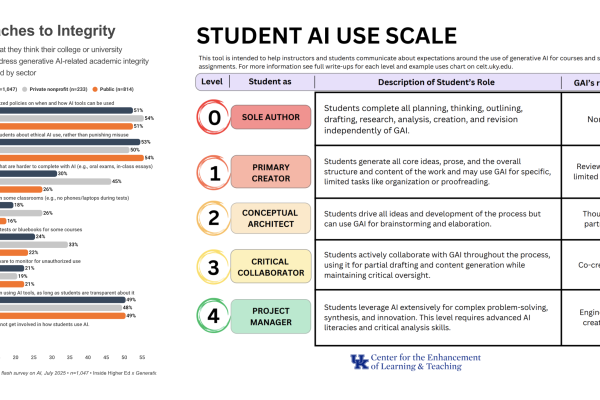
Supporting student learning in the age of generative AI involves establishing clear expectations and parameters around when and if GAI can be used. This short information session will share resources and strategies for communication with students about what constitutes appropriate use of GAI within the context of each course. Whether you want students to use GAI in your classes or avoid it for most assignments, this session will provide anchor points for informed conversations between students and instructors.

Designing Assignments to Mitigate or Enhance Student Use of Generative AI

Whether you want students to complete assignments without the help of generative AI or you want them to engage with it proficiently to build critical literacies, there are steps for assignment design and communication that can support student learning. Join us for this virtual session that consists of two parts. The first half will feature strategies that incentivize students doing their own work without the use of GAI. Part two will consider better practices for helping students use generative AI more intentionally when that is included in the learning goals.

Getting Started with Google NotebookLM

This workshop will feature an introduction and overview of Google NotebookLM as a tool for learning and teaching. Explore the uses of Google NotebookLM as a study, research, and reading tool as well as an opportunity for students to examine and critique generative AI.

UK ADVANCE Releases Updated Instructional Guidelines for GAI

UK ADVANCE has released updated guidelines for the use of generative artificial intelligence (GAI) in instructional, research, and clinical care contexts. The instructional guidelines include up-to-date research on GAI and expanded sections on AI literacy, affordances/constraints of GAI, and instructor/student use of GAI.

Apply for the AI-focused 2025-2026 CELT Teaching Innovation Institute

CELT is currently inviting applications for the 2025-26 Teaching Innovation Institute: a cross-disciplinary, year-long cohort experience for faculty eager to examine the evolving impact of generative artificial intelligence (AI) on teaching and learning. Read more about the call for applications and submit yours by April 28.

CELT Symposium on AI and Teaching

The CELT Symposium on AI and Education is the culminating event for the 2024-25 cohort of the Teaching Innovation Institute where faculty participants will present actionable findings from their year of research and experimentation with generative artificial intelligence (AI). Registration is free and anyone connected to the instructional mission of the university is welcome to attend. 

Perusall Engage Book Event on The Opposite of Cheating: Teaching for Integrity in the Age of AI

Perusall is facilitating a 4-week, asynchronous, author-facilitated communal reading experience on the forthcoming book "The Opposite of Cheating: Teaching for Integrity in the Age of AI." A Perusall Engage Book Event is an interactive virtual community event designed to explore, discuss, and engage deeply with a recently published book on teaching and learning.

Using AI to Teach Research Skills

As generative AI tools continue to develop capacity for information retrieval, organization, and synthesis, they present new opportunities for teaching key research skills. This workshop will explore ways instructors can leverage AI to help students develop essential research competencies - from refining research questions and identifying relevant sources to analyzing information and crafting literature reviews. An approach to teaching research that incorporates the critical use and exploration of AI can enhance students’ understanding of research principles while also helping them recognize when and if the use of those tools are appropriate in future projects.

Using AI for Formative Feedback

This session will introduce the affordances and constraints of using AI to generate formative feedback on writing at various stages of development, from ideation to copyediting, including strategic ways of engaging with AI for optimal output. Additionally, we will explore how instructors can integrate AI-generated feedback into students’ writing process while fostering the development of critical thinking and literacies, identifying and foregrounding the shortcomings of AI, and considering when it may not be appropriate or productive for learning.

Using AI to Augment Reading

This session will introduce the affordances and constraints of using AI to engage with readings for different purposes and demonstrate how this works with different AI tools, including strategic ways of engaging with AI for optimal output. Additionally, we will explore how instructors can integrate AI-assisted reading in students’ learning while fostering the development of critical thinking and literacies, identifying and foregrounding the shortcomings of AI, and considering when it may not be appropriate or productive for learning.