Skip to main
University-wide Navigation

Supporting & Mentoring Neurodivergent Graduate Students

Mentoring graduate students is an important part of our instructional mission. Supporting and mentoring neurodivergent students requires an intentional approach which can be achieved by implementing a few simple practices. This session provides introductory information about neurodivergent students’ learning experiences, and offers strategies, tools, and ideas for targeted support as well as overall mentoring approaches.

Syllabus Preparation Workshop

Join us for a collaborative opportunity to build, review, or polish up your syllabi. This Zoom session will provide some resources for getting your syllabus ready for the Fall 2026 semester.

New Faculty Orientation

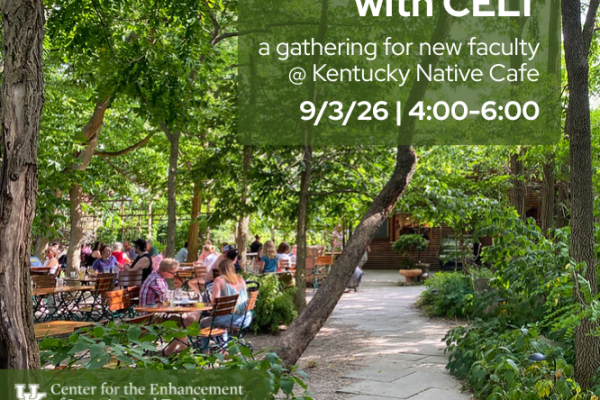
Every year we welcome new faculty to the University of Kentucky with conversations about what it takes to succeed and introductions to critical resources, offices, and support units. CELT will present on our work with faculty across the University in support of career advancement and effective teaching and learning.

Canvas and Accessibility Zoom Drop-In Office Hours

Do you need some help making your course documents and Canvas course accessible? This 2-hour open Zoom lab provides one-on-one support for instructors who are in the process of making their course materials accessible. Log on anytime during this 2-hour window and bring your questions.

Learning from Experience: An Experienced TA Panel

What do experienced TAs wish they had known when they began teaching? In this candid conversation, panelists from across disciplines will share lessons learned, practical advice, and strategies for navigating common TA responsibilities and challenges. Topics may include preparing for class, communicating with students, managing time, establishing confidence and authority, and finding support when questions arise. Participants will also have an opportunity to ask their own questions.

Making Lectures Interactive: Strategies from Experienced TAs

Even a brief lecture can create opportunities for students to think, respond, and apply what they are learning. Experienced TAs will discuss manageable ways to incorporate questions, activities, demonstrations, and other forms of interaction into lectures. Panelists will also share strategies for balancing content coverage with student engagement and adapting interactive approaches to different class sizes and teaching contexts.

Facilitating Lab Sections: Strategies from Experienced TAs

Teaching a lab involves balancing procedures, safety, time, student questions, and opportunities for meaningful learning. In this panel, experienced lab TAs will share approaches to preparing for lab sessions, explaining complex processes, supporting students without simply giving them the answers, and responding when experiments—or class plans—do not go as expected.

Leading Discussions: Strategies from Experienced TAs

How do you move beyond asking a question and hoping someone answers? Experienced TAs will share practical strategies for preparing and leading discussion sections, encouraging broad participation, responding to silence, and keeping conversations focused and productive. Panelists will also discuss common challenges and what they have learned from facilitating discussions in their own courses.

2026 Pedagogicon Conference

Pedagogicon is an annual peer-reviewed conference that brings together faculty, scholars and academic leaders designed to ignite innovation, deepen impact, and share knowledge among colleagues across Kentucky. The 2026 event will focus on the 10 Essential Skills -- how to embed them in programs, how to teach them, and how to assess student learning. With a combination of plenary sessions, faculty-led breakout sessions, and poster sessions, attendees will leave with strategies, resources, and an expanded network of colleagues working on these “essential” components to learning.

Digital Tools for Student Engagement (feat. Lucid)

Explore how digital tools like Perusall and Lucid can foster active, collaborative student engagement through shared annotation, visual thinking, and interactive learning that extend beyond traditional discussion formats adaptable to multiple teaching modalities and contexts.